Translate

Friday, February 6, 2026

BA Senior Capstone Portfolio Class

 Aiden Balog

Marysa Gunter

Tabitha Hanley

Rylie McCormick

Marysa Gunter, Student Work


Transformation #1: A Still-life
Charcoal on Paper.
36 in. x 30 in.


Transformation #2: Florida Panther
Charcoal on Paper.
36 in. x 30 in. 

        For this transformation I changed to orientation to landscape to follow the angle of the first transformation. I made darker marks with charcoal on this transformation in order for the erased highlights to be more striking. I used water to adhere the charcoal to the paper better to create different mid-tones and to also "paint" with the charcoal. I used a reference of a Florida Panther staring at the person taking the photo, but in this state it is staring at the viewer. 


Transformation #3: Knight Guard
Charcoal and Gouache Paint on Paper. 
Panels of paper taped together on back with painters tape. 
Approx. 4 ft. height. x  Approx. 30 in. width

        In this transformation, I cut the paper to create a taller layout. I was inspired by Knight armor and wanted to experiment with a black, white, and grey pallet. I sprayed water onto the charcoal to spread it with my hands, creating a mid-tone background for the drawing/painting. I mixed a grey on a painting pallet but also mixed the grey directly on the paper, which caused the paper to pebble. The pebbling was not much of a problem since once it was dry, I brushed them away to keep the paper relatively smooth. The gouache paint created opaque layers that were easy to work with, as well as fixing minor mistakes and smudges that occurred during the creation process. I would paint in sections and spray the paint with a spray bottle in order to blend the paints easily. 


 Details of #3 


Transformation #4: Handled
Charcoal and Gouache Paint on Paper. 
Panels of Paper taped together on the back with painters tape. 
Approx. 5 ft. height. x  Approx. 30 in. width.

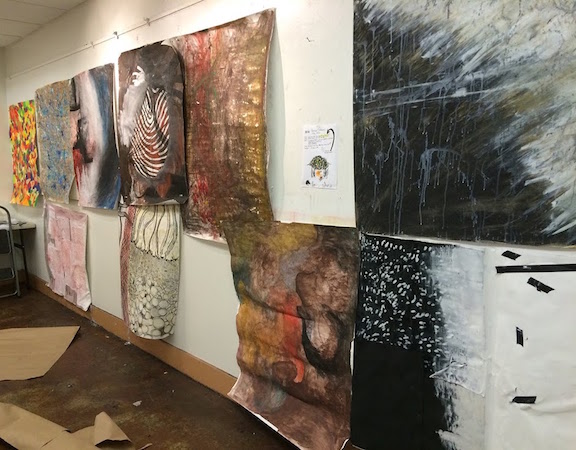
       To start transformation #4, I sprayed #3 with water and smeared the paint with my hands to create a mid-toned background.  I them rearranged and cut the paper into more panels and taped them back together again. I included red gouache paint to add a higher contrast to the black and dark grey paint. I added white paint for an reflective eye effect, with a small red streak going upwards from the pupil. For this transformation I wanted to create something more representational of feeling than just representations of things that already exist. I had different ideas sketched out but ended with the image of a six-armed figure hiding its face. With this transformation, I explored more into the style that was more prevalent in one of the quick challenges, Water.


Transformation #5: Barred Owl
Charcoal and Gouache Paint on Paper. Cardboard.
26 in. height. x 16 in. width.
/\ Pictured with the wing extended and folded in. /\

        For the final transformation, I decided to do a movable piece. After spraying #4 with water and blending out paint, I cut a piece of cardboard into a simplified outline of a Barred Owl's body and wings. I covered the cardboard in the paper and secured the wing to the base of the body. To make the wing uncurl, I put a hole into both parts of the wing, threaded a string between them, and tightly secured the string to a small piece of cardboard. I then covered the wings with the paper to hide the cardboard. With the excess pieces of paper, I cut feather-like strips and glued it to the body and wings, with the unpainted side up to create the harsh white highlights. At the end of the process I still had a large piece of paper left over. To make it go with the owl, I used watered down gesso and a toothbrush to create the white streaks and speckling. 
        While I am happy with the moveable function of the wing, I am not happy with this outcome especially after Transformations #2, #3, and #4 being so successful in what I had envisioned while working on this project. I did make a more drastic transformation with this piece, which I am proud of for pushing myself to do. 


Marysa Gunter, Student Work


Language of Birds

Cardboard, Paper, Thread

6 in. height. x 5 in. width 

Ellie Bowman, Student Work

Transformation 1

First Drawing, Transformation #1


Transformation 2

All This Ringing, pastels, 36in x 30in

During the creation of this image, I was getting over a virus that impaired my hearing and resulted in temporary tinnitus. The ringing in my ears was the only thing that I was able to focus on, so while drawing this image, I tried to portray the annoying buzzing sounds and overwhelming feeling of the tinnitus. I struggled to cover the pitch black of the original image. I found myself constantly rubbing at layers of charcoal and building up layers of color to mask it.


Transformation 3


In Red, pastels, 36 in x 30 in

I started this drawing by rubbing away the previous colors as much as I could with wet paper towels, resulting in a muddy grey and giving the paper a harder texture when it dried. I'm drawn to figures so I used sponges and pan pastels to build up shapes to create a face while I lay on the floor drawing, resulting in odd proportions. I used a red pastel to create the illusion of a sheer red fabric wrapping around the woman.


Transformation 4

Womb, pastels, 30in x 26in

I was thinking about water during this drawing. When I was thinking about water, I thought about how being submerged is sort of like being in the womb, surrounded by amniotic fluid. I covered the previous colors in grey and shades of blue to make the image feel cold. The drawing is meant to make the viewer feel both a sense of peace and sorrow, like being cradled by water yet drowning.


Transformation 5

Watching, gouache and acrylic paint, 28in x 24in

During the creation of this piece I was thinking about horror movie posters from the 1970s, specifically House (1977) and Suspiria (1977). The two posters for those films are illustrative and consist mainly of orange, red, black, and white. I cut the paper into a headstone shape and glue the cut off pieces onto the  front of the paper. Since this was the final transformation I wanted to use more permanent materials so I opted for paints. I coated the paper in black, then added the eyes. Finally I used a sponge with very little white paint on it and dragged it across the paper, resulting in an industrial texture across the drawing.


Ellie Bowman, Student Work


Transparent/Layers
Charcoal, paper, ink, plastic wrap. 


Transparent/Layers
Charcoal, tracing paper on black paper. 

Abigail Harkins, Student Work


Skylar Sheput, Student Work


LOOK PARTY
Canvas, ink, paper, soft chalk pastels, water, frames, gesso.
74" x 57" 


Ellie Bowman, Student Work

Plaything
Pastels, chalk, yarn, aper.
6ft 8in x 1ft 9in


Statement:
In my work, Plaything, I wanted to make a piece discussing women's bodily autonomy. As a woman, I've often felt that others seem to believe that they deserve to have control over my body, whether it be the government controlling what I can and cannot do with my own vessel, or men who believe I owe them to look a certain way, or feel as though they have the right to use my body for their own pleasure. The marionette does not have control of herself; her every movement is determined by a puppeteer. The white chalk and pastel are soft and dainty, just like her. The circle below her is her stage from which she cannot escape. The marionette hangs and waits for her puppet master, she cannot be allowed to function on her own.


Marysa Gunter, Student Work


Cardbird
Cardboard, String, Acrylic Paint.
5 in. width

A flying bird mobile.


Bird Tryptic 
Cardboard, Acrylic Paint, and Gel Medium.
10 1/2 in. width. x 9 1/2 in. height

A tryptic of (left to right) Wood Stork, Great Blue Heron, and Cattle Egret.

Marysa Gunter, Student Work


The Observer
Charcoal on Charcoal and Bristol paper. Fishing hooks. Fishing line. 
6 ft. Wide x 5.3 ft. Height.

\/  Details Photos \/


Artist Statement 
        The Observer is an example of the natural world that I see and interact with daily. My love and appreciation towards animals are from my personal experience of living on a farm, where I have many interactions with wildlife. The Observer in question is a Great Blue Heron, my personal favorite of birds that I see at home. These large, magnificent birds are found near marshes and other shallow waters hunting patiently for fish, amphibians, snakes, and sometimes small rodents. I chose the Great Blue Heron because of its unwavering patience and watchful eyes that observe the surroundings.  

There are times when we get a call informing us that cattle have gotten out during the night, and we must retrieve them as soon as possible, often right after the call. During these nighttime drives, we will see other animals such as White Tail Deer, Raccoons, Opossums, and our own horses and cows. The multiple charcoal drawings hanging beneath the wings of the heron depict these mentioned animals that I have observed through trail cameras and going outside during the night. Their eyes reflect to us, a sign that they know we are there, and they are comfortable yet apprehensive with our presence. These images of animals hanging by fishing lines and fishing hooks act as a commemoration of family ties and memories of fishing with my grandfather. My grandfather, who I call Papa, is the reason for my love of animals, and my love of working on the land. 

The Observer is meant to show the oppressive quiet the night can emanate and how even in the dark you can feel a sense of calm while being watched by the animals. However, it is notable that not everyone that goes outside at night feels the same calmness that I have discussed. Since I live in the woods, I am constantly surrounded by trees, ponds, animals of all species, and the ever-present state of natural quiet. Even though the “quiet” of the night is often filled with sounds of Cicadas, Crickets, Frogs, and other creatures active at night, it is a quiet found in nature. In this quiet, I find myself in the utmost peace surrounded by the sounds and watchers of the night.  


In process


Reflection/Notes:

        The heron is taped together panels of charcoal paper. The smaller images of animals are Bristol paper that has the edges ripped to create an organic border. 
        I chose to use charcoal due to its ability to be more forgiving as a medium as well as its ability to create darker images, making it easier to achieve a nighttime scene.
        I used water to spread the charcoal and to make it adhere to the paper more in order to create a darker layer with a lower chance of smudging. I used both compressed and vine charcoal. For the details I used different erasers (Pink Pearl, Staedtler, and an electric eraser) to get the different quality of highlights I was trying to achieve.