Translate

Showing posts with label Text. Show all posts

Sunday, August 18, 2013

The Broken-Hearted Sailor


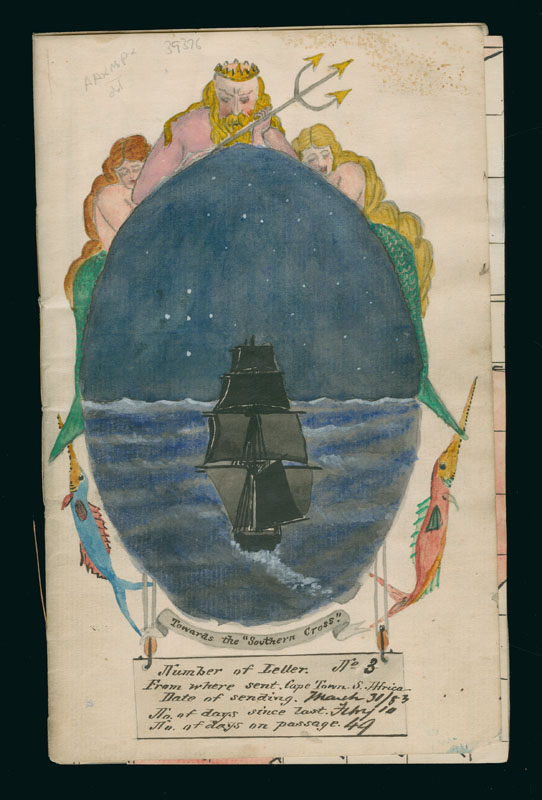
The Lilly Library recently acquired an extraordinary new addition to our collection of military manuscript diaries. In a series of illustrated letters to his fiancĂ©e, Miss Elise Buckingham of Zanesville, Ohio, Lt. Mason Abercrombie Shufeldt documents his voyage on the U.S.S. Enterprise from Cape Henry, Virgina to Capetown, South Africa, from December 27, 1882 to March 31, 1883. Describing his travels and his devotion to his “far-off sweetheart” in depth, Shufeldt decorated each of the three volumes with an elaborately hand-drawn and colored cover with nautical themes and incorporated a series of hand-drawn maps and views throughout. Included in the archive is a small envelope dramatically labeled “The Lash.” Enclosed in the envelope is a letter from Miss Buckingham ending their engagement.
A son of Robert Wilson Shufeldt, an important naval officer who played a major role in opening trade with Korea and China in the early 1880′s, Mason Shufeldt served as an officer under his father’s command aboard the Ticonderoga during its around-the-world voyage in the late 1870′s and became deeply interested in the largely uncharted island of Madagascar during an extended stop there. After receiving news of the end of his engagement, Shufeldt received permission to explore the Madagascar interior, leading a team of men of which only 153 survived to reach the waters of Mozambique Channel. At least fifty are said to have “perished in the battles which he fought with the Sakolava slave-dealers” according to a New York Times article published October 8, 1884. Shufeldt died in Capetown in 1892 at the age of thirty-nine.
– Cherry Williams, Curator of Manuscripts
Images and text source Lily Library, Indiana University.  Link here

Rachel Phillips, Artist

Source link here

Saturday, August 17, 2013

Jasna Guy, Artist


"Working with stamps and linocuts is very addictive – repetition, the basis of the process, allows for large areas to be produced within a relatively (that’s relatively) short space of time (compared to hand drawing, of course). I’m up to 9,000 bees to date and counting!
At the same time, I can cut new stamps as the muse strikes me, thus maintaining some of the individuality inherent in hand drawing. The repetition involved in creating the patterns contributes to the unity of the total piece, but further, each act of stamping or printing produces a unique imprint – the pressure applied to the paper, the amount of ink on the stamp and even accidental movements and slips of the hand create a variation in each print.  From clear impressions to strange blobs, I never quite know what I’m going to get!"


"I’m experimenting with a new way of adding the blue to the image -brushing the powdered soft pastel directly onto the surface of the scanner, and then also adding it to the petal before scanning.  Prior to this, modifications (scribbles, etc.) other than the tattooing or scribing of text with a stylus never really touched the actual petals since additions and annotations were added after-the-fact in Photoshop, or to the surface of images printed and then rescanned."


Images and text source Jasna Guy.  Link here

Wax


Source is Bloominelle.  Link here

Wednesday, August 14, 2013

Kim Rugg, Artist


KIM RUGG  
A SOLITARY RED BALLOON DRIFTING SKYWARDS
NEWSPRINT,  THE GUARDIAN
60 X 38 CM
2008


Source is the future can wait.  Link here

Thursday, November 8, 2012

Theresa Hak Kyung Cha, Artist


Untitled, 1980, clear glass jar with lid containing 5 pieces of paper with type-written text and black string.

Friday, October 12, 2012

Anamorphic Typography


"I just did a little test with something called ‘anamorphic typography’. Essentially, it is an illusion where the type looks just right when viewed from the exact right spot, but it looks stretched and warped when viewed from elsewhere in the room. We might be doing something similar in a HOLLY HUNT showrooms later this year, so I did this in a room above my parents’ garage to make sure I could pull it off when the time comes. For what it is worth, I certainly didn’t invent this sort of thing, and I’d like to give lots of credit to this project by Joseph Egan and Hunter Thompson for tipping me off to the idea, as well as the artist Felice Varini, who is doing this sort of thing on a much larger and much more impressive scale." -source is Thomas Quinn.  Link here.

Monday, August 6, 2012

Sol Lewitt, Artist

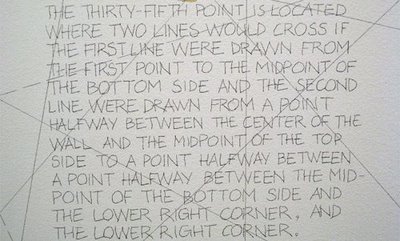
"Sol LeWitt (b. 1928) is an originator of conceptual art, in which the work of art--typically an installation rather than an art object in the conventional sense--is either incarnated by language alone or produced according to the artist's written instructions. LeWitt developed the idea for the wall drawings in the late 1960s." -from the National Gallery of Art. Link here to read more.


Image from the National Gallery of Art.

Monday, October 17, 2011