Translate

Showing posts with label Drawing Collection Artists. Show all posts

Wednesday, May 27, 2020

Gregory Raymond Halili, Artist


Gregory Raymond Halili born in the Philippines in 1975, carves and paints mother-of-pearl shells. Halili received his B.F.A. from the University of the Arts in Philadelphia. His work focuses on the art of miniatures with interest in the notion and idea of memory, life, death, and cycle. The artist is represented by the Nancy Hoffman Gallery in NYC. Follow him on Facebook

Source Link

Ajit Chauhan, Artist


Among his works, my favorite are Chauhan’s erased album covers. By removing the big picture on the cover, Chauhan leaves you questioning not what this object was, but what it now represents. In his ReRecord series, you are left with an eery collection of eyes, hair, and errant limbs all floating on cream-colored backgrounds. But what is curious is that in the end, though you know these were once record covers, you are merely interested in what is left of what you may have once known. The origin is irrelevent.
Source is Power Animals

Artist Website

Lisa Kokin, Artist

Marlene Dumas, Artist


Watercolor and ink wash on paper. 

Ellen Gallagher, Artist


Artnet. source link


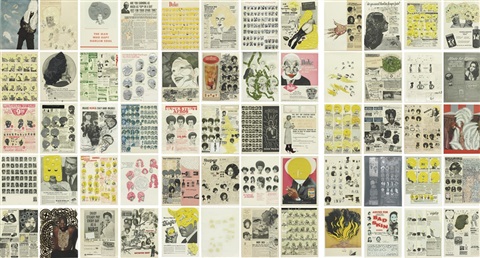
"The artist "whites out" such features as lips, hair, or wigs with yellow plastacine. These then stand out from the surface as a kind of sculptural relief, lovingly formed elements that read as a voluptuous ornamentation. They accentuate precisely the racial attributes the products were intended to diminish. The malleable putty is striated and carved in ways that recall African tribal art, although that's not the exclusive cultural reference." From article.com. Link here.


"I scan pages from advertisements about control: acne, unruly hair, corns, bunions, and asthma. These all have particular class connotations, and I remember hearing, as a child, that you got asthma from cockroaches, from enclosed spaces. Constriction is interesting to me as the loss of control of something as elemental as your breath. Corns and bunions have something specific about them too, something so black, that is funny to me. But they have a specificity that is not about race but rather about skin and about being on your feet all the time. Just like the ads have their own material history, plasticine was used for stop-action animation to suggest motion and also to make models. These structures are built out of whimsy but are also very tectonic." From Ellen Gallagher Talks. Link here.


From db artmag. Link here.
Monday, September 7, 2015

Cynthia Diagnault, Artist

This artist offers ideas for two assignments, drawing collection and multiple panel. 


drawing collection

drawing collection

drawing collection

drawing collection


multiple panel

Artist's website. Link here

Monday, August 17, 2015

Tracey Williams, Artist

A Short History of Some Other Things, 2006


“It’s about storytelling and trying to engage people. It’s a narrative that defies closure – it opens up questions – ie it doesn’t tell you what to think,” she says.
“You are put in a place where you have a different relation to things that you may already know [Disney characters, cowboys, pukeko]. When things are really familiar  you never question them. Images that you have grown up with background your psyche.”
Williams says her work is an antidote to the “grand narratives” people define themselves by. She is interested in the way people pick and choose from their life experience to define themselves. 
It’s part of the adopt-a-culture trend in modern life, she says.
“People look outside themselves to find meaning. It’s a collaging of images. US culture seems to have taken its contemporary rules off TV and we are kind of doing that here. I find that really sad. People are desperate to find an identity but they don’t stand still long enough.
“We have become such a commodified culture. I buy that car, I am that car. I buy those clothes, I am those clothes. There’s a sad lack of ethics underneath it.”
In identifying ourselves or our race as possessing certain traits, we risk overlooking shared humanity, she says.

Image and text source from ARTZONE