Contemporary Drawing Practices ART 304
Showing posts with label Newspaper. Show all posts
Showing posts with label Newspaper. Show all posts
Wednesday, May 27, 2020


Ellen Gallagher, Artist
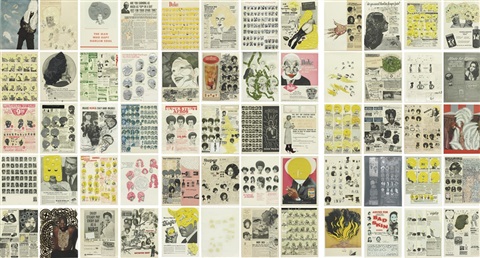
Artnet. source link


Monday, August 29, 2016


Sunday, September 22, 2013
Sunday, August 18, 2013


Saturday, August 17, 2013
La Huy, Artist
 |
| In the foreground, Vietnamese national newspapers rolled into wax turns become scrolls of a warped devotional nature. In this room, I enjoy the witty mixture of ordinary food and daily information presented alongside lengthy religious texts that are by no means fast to consume or disposable and quickly forgotten. Source is Cristina Nual Art. Link here. |
Wednesday, August 14, 2013
Rosie Leventon, Artist

PERSIAN / HANDWRITING 2008
text drawing
Part of an ongoing series of drawings using text - in this case Middle Eastern text - in different ways. This one is a Persian newspaper overlaid with handwriting in English.
Materials: Ink, graphite on newspaper.
Dimensions: 58 x 75 cm
Source link here.


Kim Rugg, Artist

KIM RUGG
A SOLITARY RED BALLOON DRIFTING SKYWARDS
NEWSPRINT, THE GUARDIAN
60 X 38 CM
2008
Source is the future can wait. Link here.
Wednesday, December 12, 2012
Christian Holstad, Artist


"Christian Holstad’s erased newsprint photographs, known collectively as the Erasurehead series, began as a way of killing time. Working as a waiter in a restaurant after graduation from art college, Holstad began to erase the images in newspapers while waiting for customers, finding that the action of rubbing out became a way of probing the complex depths of each image. Erasing is a kind of negative drawing: its marks are gestural, reminiscent of the physical action of the artist’s hand and arm, and yet their residue is a kind of blankness. Photographs in newspapers are used to widen the implications of the stories they accompany through the willful ambiguity of imagery: they say more than they mean."
Image and text source link here.
Sunday, October 14, 2012


Wednesday, February 1, 2012
Antonio Vega Macotela

"To say that Antonio Vega Macotela’s first solo exhibition in the U.S. speaks softly is to miss the point. The Mexican artist’s spare installation at Steve Turner Contemporary highlights acts of communication that occur just below the surface of everyday life, in particular a distorted writing system used by Mexican drug traffickers, and the secret dreams of soldiers. The results are intriguing, but in the end, perhaps a little too quiet.
Macotela placed ads in Mexican newspapers using an anamorphic writing system: the letters in the ads can only be read from an extreme angle. In the exhibition, the papers are pinned to the wall, so reading the ads involves kneeling (cushions are provided), and pressing your body uncomfortably against the vertical surface. Macotela succeeds in manipulating the viewer into a penitent posture, but the reward for our submission is slight. The messages, still rather difficult to read, are all versions of the same sentence in Spanish, translated: “Here, this way even, I murmur.” There is no secret to be learned, only the recognition that another level of communication exists beneath the public babble of the news.
The show’s sole video work is similarly frustrating: a series of closeups of lips mouthing inaudible words. We’re told the speakers are soldiers in the Mexican military recounting their dreams, but why can’t the dreams be spoken aloud? Are they too horrific? Too personal? Like the newspapers, the video draws us in, only to shut us out. On a certain level, this makes sense: exposing the underground means that it’s no longer underground. But is it enough simply to know it’s there?"

Source is LA Times. Link here.
Subscribe to:
Posts (Atom)