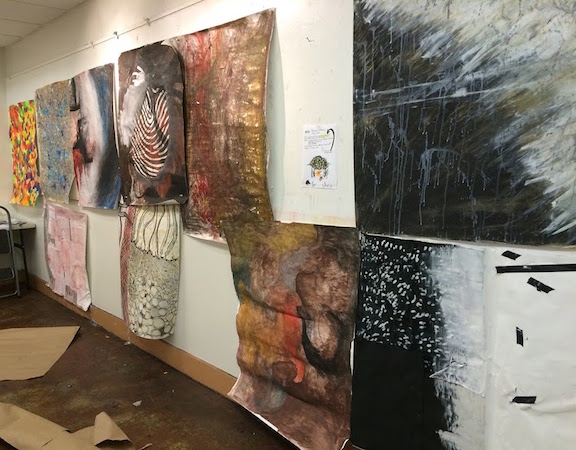
Contemporary Drawing Practices ART 304
Monday, September 7, 2015


Wednesday, September 2, 2015
Friday, August 28, 2015
Rebecca Horn, Artist


But her early body modification pieces were possibly inspired by a year spent in a sanatorium during her youth, not too long after her lungs became diseased, infected by what she terms poisonous materials. Whether such experiences really were the starting point for a career saturated with work focused on body modification is one not worth speculating; but her subsequent bandages, prosthetics and masks have their root somewhere, be it in Germany’s collective post-war experience, or in her own individual psychological makeup. Above image and text source is notey.com

 |
| Cocoon |
Thursday, August 27, 2015


Thursday, August 20, 2015
Wednesday, August 19, 2015
The Academy of Linceans

The Eye of the Lynx
GALILEO, HIS FRIENDS, AND THE BEGINNINGS OF MODERN NATURAL HISTORY
Some years ago, David Freedberg opened a dusty cupboard at Windsor Castle and discovered hundreds of vividly colored, masterfully precise drawings of all sorts of plants and animals from the Old and New Worlds. Coming upon thousands more drawings like them across Europe, Freedberg finally traced them all back to a little-known scientific organization from seventeenth-century Italy called the Academy of Linceans (or Lynxes).Founded by Prince Federico Cesi in 1603, the Linceans took as their task nothing less than the documentation and classification of all of nature in pictorial form. In this first book-length study of the Linceans to appear in English, Freedberg focuses especially on their unprecedented use of drawings based on microscopic observation and other new techniques of visualization.
Where previous thinkers had classified objects based mainly on similarities of external appearance, the Linceans instead turned increasingly to sectioning, dissection, and observation of internal structures. They applied their new research techniques to an incredible variety of subjects, from the objects in the heavens studied by their most famous (and infamous) member Galileo Galilei—whom they supported at the most critical moments of his career—to the flora and fauna of Mexico, bees, fossils, and the reproduction of plants and fungi. But by demonstrating the inadequacy of surface structures for ordering the world, the Linceans unwittingly planted the seeds for the demise of their own favorite method—visual description-as a mode of scientific classification.
Profusely illustrated and engagingly written, Eye of the Lynx uncovers a crucial episode in the development of visual representation and natural history. And perhaps as important, it offers readers a dazzling array of early modern drawings, from magnificently depicted birds and flowers to frogs in amber, monstrously misshapen citrus fruits, and more.
Subscribe to:
Posts (Atom)